
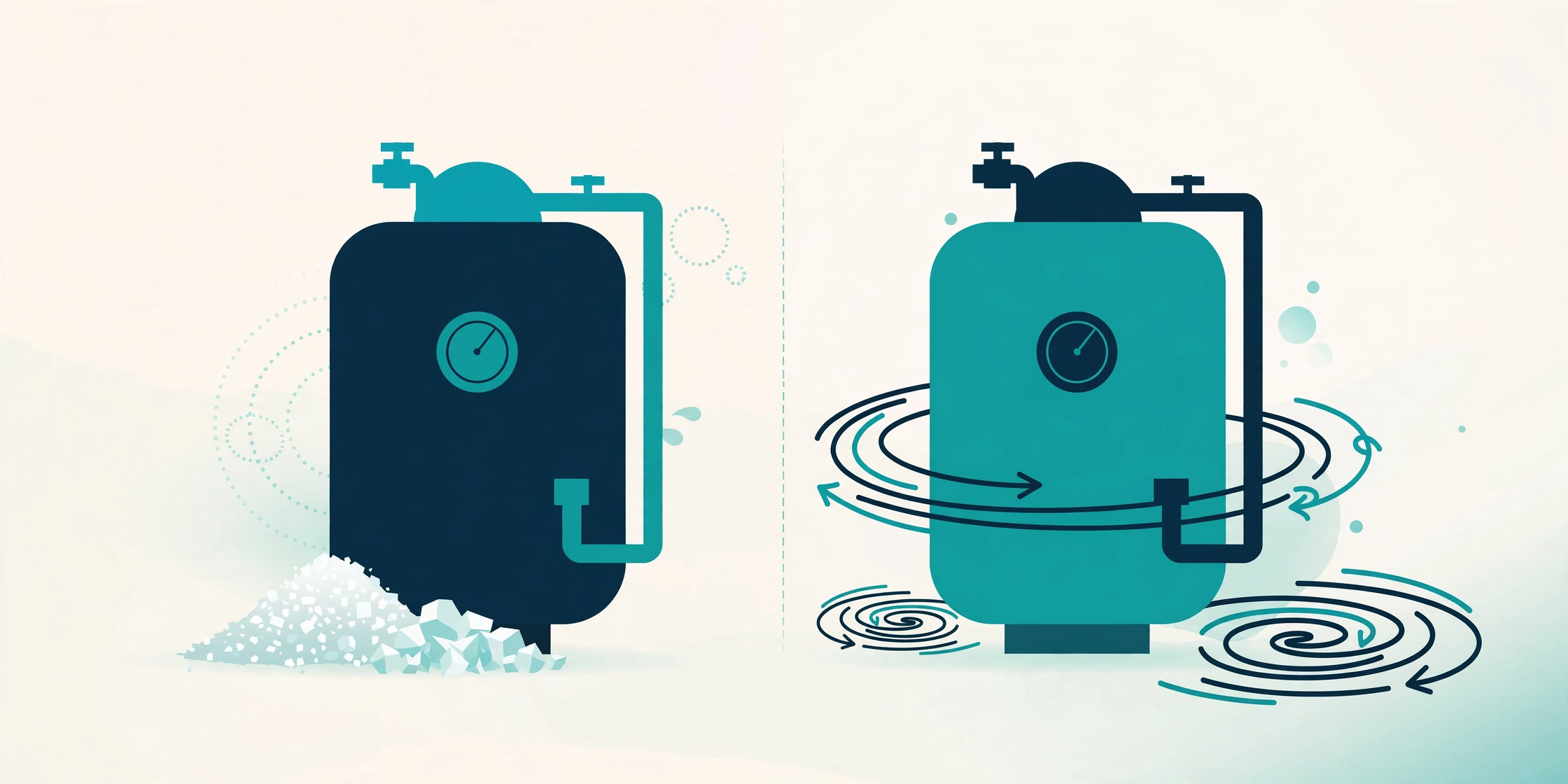
If you are shopping for a water softener, the most important fact in this category fits in one sentence: a salt-based softener removes hardness minerals from your water, and a salt-free conditioner does not. Everything else — the feel of the water, spots on glasses, what a hardness test reads after treatment, and what any certification actually proves — follows from that difference. The confusion is understandable. Both are sold in similar tanks, both are marketed for scale, and the words softener, conditioner, and descaler are used almost interchangeably. They are not interchangeable machines.
This guide explains mechanisms first, then brands and money. We cover three approaches: ion exchange, which is true softening; template-assisted crystallization (TAC), which is scale inhibition; and citric-acid chelation, which is neither. We also cover the certification gap that shapes this market: NSF/ANSI 44 exists for ion-exchange softeners, and no NSF standard certifies salt-free softening — because salt-free systems do not soften.
Disclosure: TapChecked is reader-supported. If you buy through links on this page we may earn a commission, at no extra cost to you. It never changes which products we pick or how we rank them. See how we check and our full disclosure.
Quick verdict: If your problems are soap scum, stiff laundry, spots that survive the dishwasher, and scale, you need actual softening — and only a salt-based ion-exchange softener delivers it. If your only problem is scale inside pipes and a water heater, you cannot or will not use salt or a drain, and you accept that your water will still test hard and still spot, a TAC conditioner is a reasonable, low-maintenance alternative. Chelation is a third lane: compact scale help in moderate hardness, paid for in frequent cartridges. Size any system with our softener sizing calculator first.
Key takeaways
- Salt-based softeners remove hardness minerals; salt-free conditioners do not — a test strip will still read hard after a conditioner.
- Buy ion exchange if you want soft water you can feel and measure; buy TAC only for scale protection, with your eyes open.
- Chelation (NuvoH2O) is a cartridge-funded middle path for moderate water — price it over five years.
- The worst purchase in this category is any machine bought under the wrong name.
The three technologies, side by side
The row that matters most is the second one. A hardness test cannot be marketed around.
| Question | Salt-based ion exchange | TAC / scale inhibitor | Citric-acid chelation |
|---|---|---|---|
| Removes calcium and magnesium? | Yes | No — minerals stay in the water | No — minerals stay, bound by citrate |
| Hardness test after treatment | Near 0 grains per gallon (gpg) | Essentially unchanged | Essentially unchanged |
| How it limits scale | Removes the minerals that form scale | Forms tiny crystals that resist sticking | Citric acid binds minerals and lowers pH slightly |
| Salt, drain, power? | Salt and drain yes; usually power for the valve | No salt, drain, or regeneration wastewater | No salt or drain; cartridges dissolve and are replaced |
| Certification for the softening claim | NSF/ANSI 44 exists — check the exact system listing | None for softening; media may carry NSF/ANSI 61 material certification | None for softening |
| Best fit | Whole-house soft-water benefits | Scale-only protection without salt or a drain | Compact scale help in low-to-moderate hardness |
How ion exchange actually softens water
An ion-exchange softener holds resin beads loaded with sodium (or sometimes potassium) ions. As hard water flows through, calcium and magnesium trade places with the sodium and stay in the tank. The water leaving is softened in the literal chemical sense: its hardness has been taken out. When the resin fills with hardness minerals, the system regenerates: a salt solution from a brine tank restores the sodium, and the rinse water carrying the hardness goes down a drain. A metered valve such as the Pentair Fleck 5600SXT regenerates based on water actually used, saving salt and water versus old timer designs.
Because the minerals are gone, the effects are broad. Soap lathers instead of forming scum. Detergent works closer to its intended dose. Glassware spots far less. Scale cannot build from minerals that are no longer there. And the check is clean: a working softener brings a sample from, say, 12 gpg to near 0 gpg.
The costs are real. You buy and carry salt. You need a drain and space for two tanks. Regeneration uses water. Treated water carries a small amount of added sodium, roughly proportional to the hardness removed, which is why many installs leave an outside tap — and sometimes a kitchen cold tap — unsoftened. None of that changes the mechanism: this is the only technology here that removes hardness.
On certification, precision matters. Pentair states its Fleck 5600SXT valve is tested and certified by WQA to NSF/ANSI 44 for softener performance. That valve-level fact does not automatically give every dealer-built system using that valve its own NSF/ANSI 44 listing. Ask for the listing for the exact complete system and check it in the NSF, WQA, or IAPMO directory. Our best water softener systems round-up and our SpringWell vs SoftPro vs Fleck 5600SXT comparison apply that rule model by model.
- Pros: only option that lowers hardness to near zero; benefits beyond scale — scum, laundry, spotting; performance measurable at the tap; NSF/ANSI 44 is a real, checkable standard
- Cons: needs salt, a drain, and floor space; uses regeneration water and discharges brine; adds a small amount of sodium; professional install can be costly
What TAC conditioners actually do
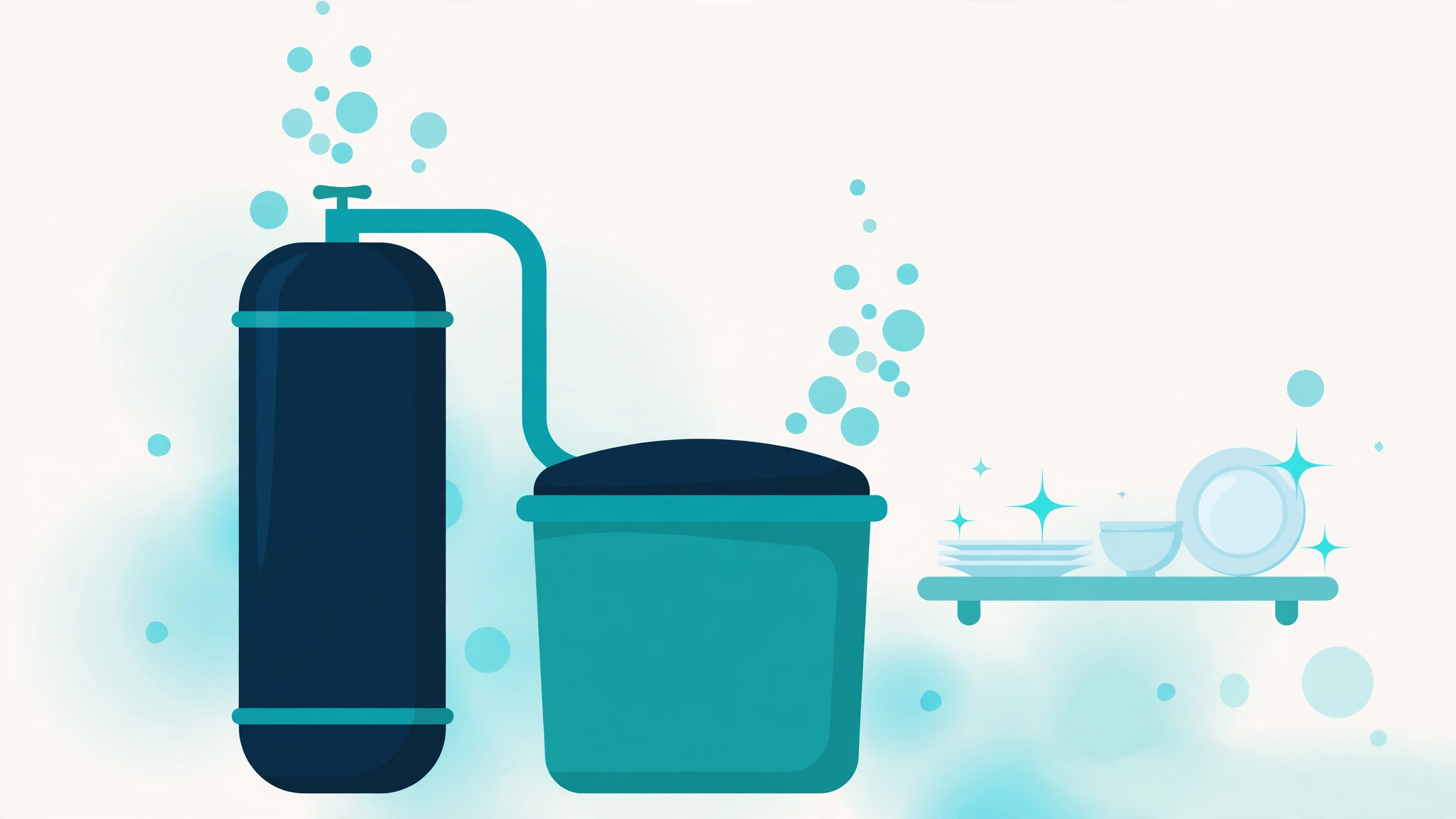
A TAC conditioner flows water over polymer media covered in nucleation sites. Dissolved calcium and bicarbonate form tiny, stable crystals on those sites, then detach and travel with the water. Locked in crystal form, the hardness is far less likely to stick to pipe walls, heating elements, or fixtures as hard scale. Watts describes the same process for its OneFlow line as media-assisted crystallization, and states plainly in its documentation that OneFlow is not a water softener. SpringWell makes the same distinction for FutureSoft: conditioner, not softener.
Nothing is removed, so these systems need no salt, no drain, and no regeneration — there is nothing to flush. It also means they cannot deliver soft water’s other effects. The minerals remain to react with soap, to dry as spots, and to show up on a hardness test. Careful manufacturers say exactly this. Marketing that promises slippery water and spot-free dishes from a TAC tank promises effects the mechanism does not produce.
What does the evidence say about scale? Carefully: TAC performs well on scale formation and, by design, does nothing measurable on hardness removal. Watts manuals cite independent testing under a protocol based on the German DVGW W512 method reporting scale reduction above 95 percent for TAC media under test conditions. An Arizona State University evaluation of softener alternatives found the TAC device tested reduced scale formation by more than 88 percent across the waters evaluated, ahead of the electromagnetic devices in the same study. A University of Waterloo thesis, meanwhile, found only a few percent reduction in calcium and magnesium after TAC — exactly what the mechanism predicts. Both can be true: crystals can resist scale while hardness readings barely move.
Feed-water limits matter. TAC media typically requires a stated pH range and little or no iron, manganese, hydrogen sulfide, or oil, plus a maximum hardness — Watts lists up to 30 gpg for its cartridge OneFlow systems. SpringWell lists its own pH and contaminant limits for FutureSoft. Well water with iron is a common reason TAC disappoints; pre-treatment changes both cost and complexity. Examples: the SpringWell FutureSoft family is a whole-house tank format with media rated for years, while the Watts OneFlow Plus pairs a carbon cartridge with a TAC cartridge in a compact housing for a branch or a whole small home.
- Pros: no salt, drain, or wastewater; very low maintenance with media lasting years; can substantially reduce hard scale inside pipes and heaters under the right conditions; often permitted where brine is restricted
- Cons: water still tests hard, forms scum, and can spot; no NSF certification for softening because there is no softening; feed-water limits narrow where it works; scale evidence is technology- and media-level, not a certified listing for each system
Chelation: the third lane — NuvoH2O
NuvoH2O is shelved with TAC because both are salt-free, but the mechanism differs. Its cartridge slowly dissolves a citrus-based formula, CitraCharge, into the water. The citric acid chelates hardness minerals — binding calcium and magnesium into a form less likely to form scale — and lowers pH slightly. NuvoH2O says this itself in its help centre: it does not remove minerals, it changes them into a form that does not form scale, and its cartridges dissolve over about six months, with the Home cartridge rated up to 50,000 gallons.
So ownership is consumable-based. There is no media bed lasting years; you replace cartridges on schedule, and annual cost follows your water use and hardness. NuvoH2O warns against already-acidic water, listing a minimum pH in its guidance, and advises caution above 25 gpg. Price a NuvoH2O system as a subscription you buy in cartridges, not as a one-time appliance.
- Pros: compact housing; no salt, drain, or electricity; lower upfront price than most TAC tanks; simple cartridge swaps
- Cons: still no hardness removal; highest ongoing cost of the three in our maths below; unsuited to acidic water or very high hardness; no NSF certification for softening
The certification gap, honestly
NSF/ANSI 44 covers residential cation-exchange softeners: hardness reduction, efficiency, material safety, and structure. A system certified to it has been checked for softening as claimed. That promise exists only on the salt-based side. There is no NSF standard certifying salt-free softening, because the claim does not fit the chemistry.
Salt-free products may carry other certifications — read them for what they are. NSF/ANSI 61 covers safety of materials contacting drinking water. NSF/ANSI 372 covers lead content in materials. Watts states its OneFlow media is certified by WQA to NSF/ANSI/CAN 61 and 372, and the OneFlow Plus system to 372 for lead-free compliance; SpringWell’s Filtersorb SP3 TAC media is likewise described as carrying NSF/ANSI 61 material certification. Material safety matters, but it certifies what media is made of — not a scale percentage, and not softening. A separate standard, IAPMO/ANSI Z601, provides a test method for scale-reduction devices; even there, distinguish a study of TAC as a technology, a test of one media, and a listing for the complete system you are buying.
The water-test reality check
Take a hardness reading before the system, then at a treated tap. With ion exchange, the second reading should be near 0 gpg. With TAC or chelation, it should be essentially unchanged — and that does not mean the conditioner is broken. It was never built to change that number. This is the largest source of disappointed reviews in the category: a buyer installs a conditioner expecting a softener, sees 15 gpg before and after, and concludes it does nothing. Scale can only be judged slowly, by inspecting an aerator, kettle, or heater element over months. If you need a number you can verify on day one, you need ion exchange.
How to tell them apart when shopping
- Softener should mean ion exchange and hardness removal. If a salt-free product uses the word, check its mechanism.
- Conditioner usually signals TAC or chelation: scale behaviour changes, hardness does not.
- Descaler / scale inhibitor is the most honest salt-free label — and the narrowest promise.
- Salt-free says only what a system does not use. It says nothing about what it does.
- No-salt softener is a contradiction. Ask: does it remove calcium and magnesium, yes or no?
Hardware tells help too. A brine tank, drain line, and regeneration setting mean ion exchange. A single tank with no drain and media rated in years usually means TAC. A small housing with a cartridge rated in months and gallons, plus citrus language, means chelation. A softener states a grain capacity; a conditioner states a maximum hardness and a scale percentage. Different promises, because they are different machines. Our water softeners hub collects our sizing and comparison guides by problem.
Septic, drains, and brine restrictions
An ion-exchange softener needs somewhere for regeneration water to go. On municipal sewer that is usually straightforward, subject to local code. On septic, the extra water and salt are legitimate considerations: metered systems regenerate far less than old timer models, but size correctly and ask your septic provider if your system is marginal. Brine is also restricted in some places: some municipalities limit or prohibit softener brine discharge, typically because treatment plants cannot remove salt and reclaimed water becomes harder to reuse. Before buying, confirm brine discharge is permitted at your home. If it is not, that alone settles this comparison in favour of a conditioner — limitations accepted, not wished away.
What five years actually costs
Purchase price is the worst comparison here, because running costs run in opposite directions: ion exchange is often cheapest to buy and costs money yearly; TAC tanks cost more upfront and almost nothing to run; chelation starts cheap and charges in cartridges. The maths below uses representative configurations, excludes professional installation (budget similar plumbing cost for any whole-house system), and uses approximate prices where makers publish no single stable figure. Prices checked November 2026.
| Representative system | Purchase (approx.) | Running costs, 5 years | 5-year total (approx., ex-install) |
|---|---|---|---|
| Ion exchange — 48,000-grain Fleck 5600SXT build | Around $750 | Salt around $70/yr = $350; regeneration water/sewer around $25/yr = $125 | Around $1,225 |
| TAC tank — SpringWell FutureSoft FS1 | Around $1,600 | No salt or wastewater; pre-filter changes where fitted around $20/yr = $100; media rated beyond 5 years | Around $1,700 |
| TAC cartridge — Watts OneFlow Plus | Around $750 | Yearly carbon cartridge plus one TAC replacement in the window, around $520 total | Around $1,270 |
| Chelation — NuvoH2O Home | Around $650 | Cartridges around $110, roughly every 6 months; 9 replacements after the included one = around $990 | Around $1,640 |
Read the totals with your problem in mind. The ion-exchange row is the only one buying soft water, and it is cost-competitive over five years in a sensibly priced system. The FutureSoft row buys the lowest-effort ownership and no brine, for scale protection only. The OneFlow Plus row shows format matters: the same TAC idea in cartridge form costs less upfront, with moderate cartridge costs. The NuvoH2O row warns against sticker-price judging — the cheapest box becomes mid-pack because the treatment is a consumable. Hardness, household size, and the plumbing quote move every total.
Who should skip this
Skip ion exchange if brine discharge is prohibited where you live, if you have no viable drain, or if you know you will not carry salt — an unmaintained softener is worse than a deliberate conditioner. Skip TAC if your complaints are scum, laundry or hair feel, or dishwasher spotting; if your well water carries iron or manganese you are not pre-treating; or if you need a hardness number to prove performance. Skip chelation if your water is very hard, already acidic, or high-volume. Skip all three if your issue is drinking-water taste or a single contaminant — that is filtration, not softening.
How to choose: a decision tree by problem
- Soap scum + appliance scale + spots: ion exchange. Your list includes effects only hardness removal delivers.
- Scale inside pipes and the water heater, little else: TAC is defensible, especially on city water within its feed-water limits.
- Scale-only in a brine-restricted or salt-averse home: conditioner, with hard-testing water accepted as the trade.
- Compact space, moderate hardness, simple cartridge swaps: consider chelation — after the five-year cartridge maths.
- Very hard water, well water with iron, or whole-house feel matters: start with ion exchange, sized correctly, with pre-treatment where needed.
Size before you shop: grain capacity depends on hardness, household size, and daily use; conditioner flow depends on bathrooms and simultaneous demand. Run your numbers in our softener sizing calculator, then compare exact models via our water softeners hub, best water softener systems, and the SpringWell vs SoftPro vs Fleck 5600SXT comparison.
Frequently asked questions
Is a salt-free water softener really a softener?
No, technically. Softening means removing calcium and magnesium, which TAC and chelation do not do. They are conditioners or scale inhibitors. The distinction determines what a test reads, how soap behaves, and whether spotting improves.
Why does my water still test hard after a conditioner?
Because the minerals are still in it, by design. TAC crystallises them and chelation binds them, but neither removes them, so a test reads essentially the same grains per gallon before and after.
Does TAC actually prevent scale, or is it marketing?
The technology has credible scale support under test conditions — including DVGW W512-based protocol testing and a university evaluation reporting over 88 percent scale reduction for the device tested — but that is not a certified softening claim for a specific system. Expect less hard scale within the maker’s feed-water limits, not soft water.
Can I use a salt-based softener on septic?
Often yes, with a correctly sized metered system, but it depends on septic capacity and local rules. The water and salt load are real. Confirm with your septic provider and installer, and check whether brine discharge is restricted locally.
What does NSF/ANSI 44 certify?
Residential cation-exchange softeners: hardness reduction, efficiency, material safety, and structure. It applies to ion exchange. Marks such as NSF/ANSI 61 or 372 on salt-free media concern material safety or lead content, not softening or scale performance.
Which is cheaper over five years?
On our representative maths, a sensibly priced ion-exchange system and a cartridge TAC system are comparable; a TAC tank costs more upfront and almost nothing to run; chelation costs more than its sticker suggests. Installation, hardness, and household size move every total.
Closing verdict
Buy the mechanism that matches your problem, not the label that sounds softest. If you want soft water — measurably, at the tap, in laundry and shower — buy ion exchange and accept the salt, drain, and brine. If you want scale protection without salt or a drain, and the rest of the hard-water experience honestly does not bother you, buy TAC with your eyes open about what a test strip will still say. Treat chelation as a compact, cartridge-funded middle path for moderate water, priced over five years. The worst purchase here is any of these machines bought under the wrong name.